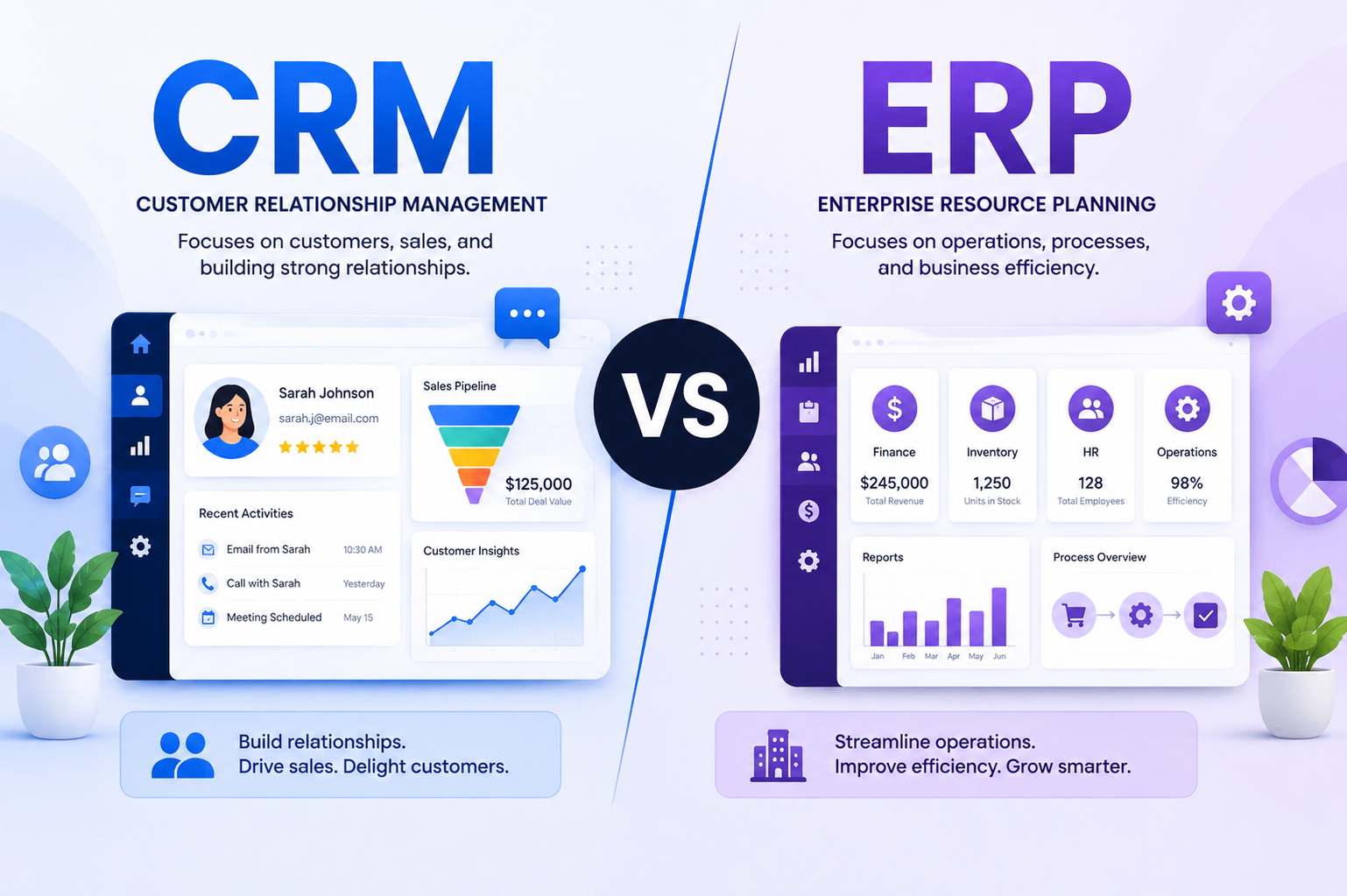
As businesses grow, managing customers, sales, finances, employees, and daily operations becomes increasingly complex. To stay organized and competitive, many companies invest in business management software.
Two of the most common systems businesses encounter are CRM and ERP. While these terms are often mentioned together, they serve different purposes and solve different business challenges.
Understanding the difference between CRM and ERP can help business owners choose the right solution and build a stronger foundation for growth.
What Is CRM?
CRM stands for Customer Relationship Management.
A CRM system is designed to help businesses manage interactions with prospects and customers throughout the sales journey. Its primary goal is to improve customer relationships, increase sales opportunities, and enhance customer satisfaction.
Typical CRM features include:
- Lead management
- Contact management
- Sales pipeline tracking
- Tasks and follow-ups
- Meeting and call logging
- Opportunity management
- Sales reporting
- Customer communication history
CRM software focuses mainly on customer-facing activities and sales processes.
What Is ERP?
ERP stands for Enterprise Resource Planning.
An ERP system is a comprehensive business management platform that integrates multiple departments and operational processes into a single system.
Unlike CRM, which focuses primarily on customers and sales, ERP manages the broader operations of the organization.
A typical ERP system may include:
- Customer management
- Sales and invoicing
- Purchasing
- Inventory management
- Accounting and finance
- Human resources
- Project management
- Reporting and analytics
ERP provides a centralized database that allows all departments to work with the same information in real time.
The Main Difference Between CRM and ERP
The simplest way to understand the difference is this:
CRM Focuses on Revenue Growth
CRM helps businesses:
- Generate leads
- Track sales opportunities
- Improve customer relationships
- Increase conversion rates
- Enhance customer retention
Its primary objective is to support sales and customer success teams.
ERP Focuses on Operational Efficiency
ERP helps businesses:
- Manage internal operations
- Control costs
- Improve productivity
- Streamline workflows
- Monitor company performance
Its primary objective is to improve the efficiency of the entire organization.
A Practical Example
Imagine you own a digital services company.
A potential client contacts your business.
The CRM system helps you:
- Capture the lead
- Schedule follow-ups
- Track conversations
- Manage the sales opportunity
- Monitor the sales pipeline
Once the client accepts your proposal, the ERP system takes over by helping you:
- Create a project
- Generate invoices
- Track payments
- Assign employees
- Record expenses
- Monitor project progress
- Generate financial reports
In simple terms, CRM helps you win customers, while ERP helps you deliver and manage the work efficiently.
When Do You Need a CRM?
A CRM system may be enough if your business:
- Is primarily focused on sales activities
- Has a small team
- Needs better lead tracking
- Wants to improve customer communication
- Struggles with managing prospects and opportunities
Many startups and growing businesses begin with CRM software before implementing a full ERP system.
When Do You Need an ERP?
An ERP system becomes valuable when:
- Your company is growing rapidly
- Multiple departments need to collaborate
- Financial management becomes more complex
- You need operational visibility
- Several disconnected tools are creating inefficiencies
- Business processes need standardization
At this stage, managing operations through spreadsheets and separate applications often becomes unsustainable.
Can CRM and ERP Work Together?
Absolutely.
Many organizations use both CRM and ERP systems because they complement each other.
When integrated properly:
- Customer data flows automatically between systems
- Sales orders can generate invoices instantly
- Teams work with consistent information
- Reporting becomes more accurate
- Manual data entry is reduced
This creates a seamless workflow from the first customer interaction to final payment and project delivery.
Why Modern ERP Systems Include CRM Features
Modern cloud ERP solutions increasingly include built-in CRM functionality.
This approach provides several advantages:
- One centralized platform
- Reduced software costs
- Consistent data across departments
- Simpler user management
- Better reporting and analytics
Instead of purchasing and integrating multiple systems, businesses can manage customers, sales, operations, and finances from a single solution.
Which Solution Is Best for Small and Medium Businesses?
For many small and medium-sized businesses, an ERP platform with integrated CRM functionality offers the best long-term value.
A unified platform allows companies to manage:
- Customers
- Leads
- Sales
- Invoices
- Expenses
- Projects
- Employees
- Financial reporting
from one centralized dashboard.
This improves efficiency, reduces administrative work, and provides better visibility into business performance.
Conclusion
CRM and ERP are not competing systems. They serve different purposes and often work best together.
CRM helps businesses attract, manage, and retain customers, while ERP helps organizations manage operations, finances, resources, and internal processes.
As businesses grow, having both customer management and operational management within a unified platform can significantly improve productivity and decision-making.
Choosing the right solution depends on your current business needs, growth stage, and operational complexity. For many growing businesses, a modern ERP with built-in CRM capabilities provides the most scalable and efficient path forward.