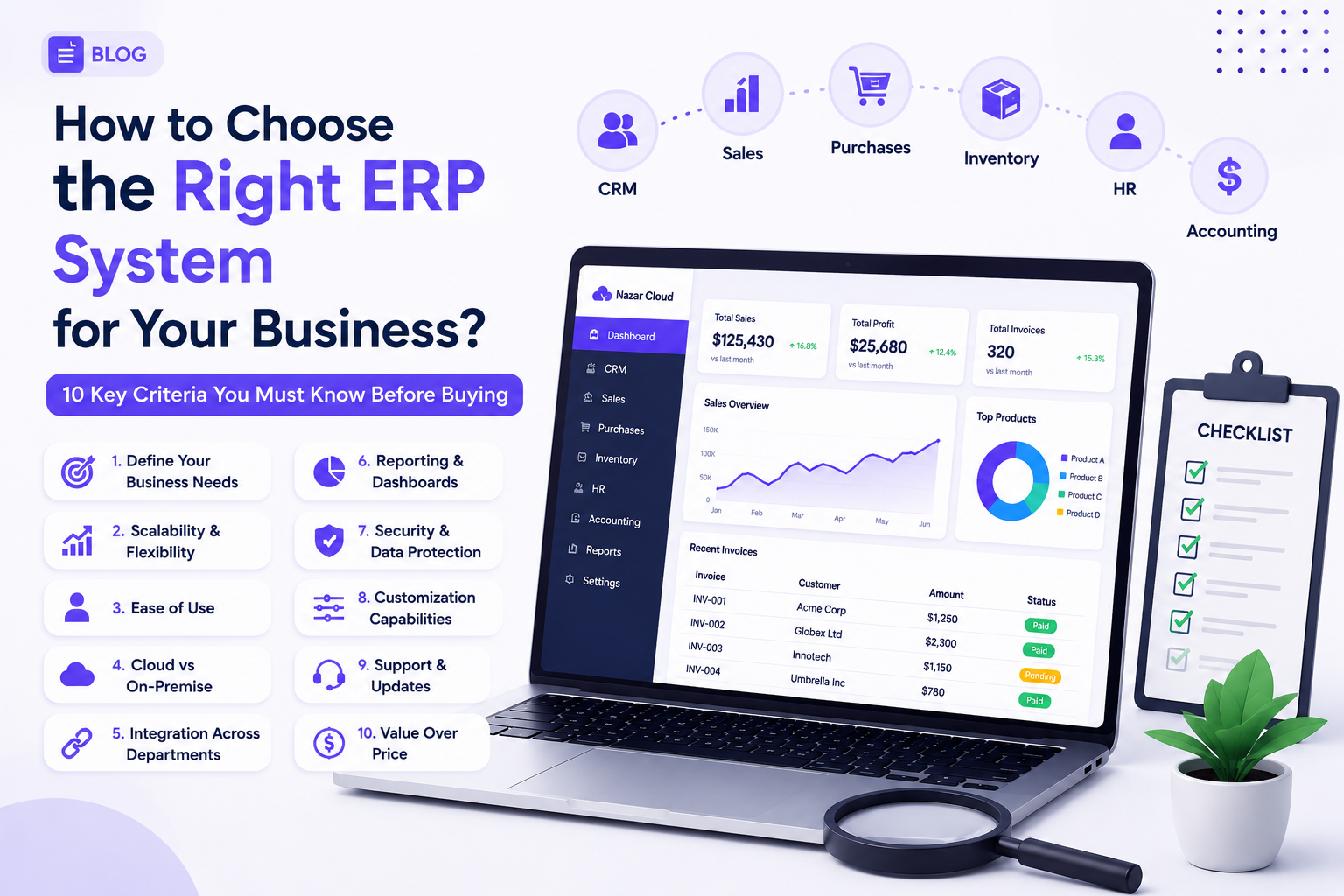
Choosing an Enterprise Resource Planning (ERP) system is one of the most important technology decisions a business can make. The right ERP software can streamline operations, improve productivity, and provide valuable insights that support long-term growth. The wrong choice, however, can lead to unnecessary costs, poor user adoption, and operational challenges.
With hundreds of ERP solutions available today, selecting the right platform can feel overwhelming. Every vendor promises powerful features, but not every solution is suitable for your business.
This guide explains the ten most important factors to consider before investing in an ERP system.
1. Understand Your Business Requirements
Before comparing ERP solutions, identify the challenges you want to solve.
Ask yourself:
- Are customer records difficult to manage?
- Do you struggle with invoicing and accounting?
- Are projects becoming harder to track?
- Do you need inventory management?
- Are your departments using disconnected software?
Having clear objectives makes it much easier to evaluate different ERP platforms.
2. Choose a System That Can Grow with Your Business
Your business today may have:
- 5 employees
- One office
- A few hundred customers
But what about three or five years from now?
A modern ERP system should be able to scale as your business grows by supporting:
- More users
- Multiple branches
- Additional business modules
- Larger amounts of data
- Increased transaction volumes
Choosing a scalable ERP reduces the need for costly migrations in the future.
3. Prioritize Ease of Use
Even the most powerful ERP software will fail if employees find it difficult to use.
Look for a system with:
- A clean user interface
- Simple navigation
- Fast workflows
- Minimal training requirements
An intuitive ERP improves employee adoption and increases overall productivity.
4. Cloud ERP or On-Premise ERP?
Today, cloud ERP solutions have become the preferred choice for many businesses.
Cloud ERP offers several advantages:
- Access from anywhere
- Lower infrastructure costs
- Automatic software updates
- Secure cloud backups
- Faster implementation
On-premise ERP may still be appropriate for organizations with specific compliance or infrastructure requirements, but for most small and medium-sized businesses, cloud ERP provides greater flexibility and lower maintenance costs.
5. Integration Across Departments
One of the main purposes of an ERP system is to connect different business functions.
Your ERP should integrate:
- Customer Relationship Management (CRM)
- Sales
- Purchasing
- Inventory
- Accounting
- Human Resources
- Projects
- Reporting
When departments share the same data, collaboration improves and manual work decreases.
6. Reporting and Business Intelligence
Data alone is not enough.
A good ERP system should provide clear dashboards and reports that help decision-makers understand business performance.
Look for features such as:
- Financial reports
- Sales analytics
- Expense reports
- Project performance
- Employee productivity
- Real-time dashboards
Accurate reporting enables faster and more informed business decisions.
7. Security and Data Protection
ERP software contains some of the most valuable information within a business.
This includes:
- Customer data
- Financial records
- Employee information
- Sales history
- Business documents
Choose an ERP platform that offers:
- Role-based permissions
- Data encryption
- Audit logs
- Regular backups
- Secure authentication
Protecting business data should always be a top priority.
8. Customization and Flexibility
Every business has unique processes.
Rather than forcing your company to adapt to software limitations, choose an ERP that allows customization.
Useful customization options include:
- Custom fields
- Custom workflows
- User roles and permissions
- Status management
- Business-specific forms
Flexible ERP software can better support changing business requirements over time.
9. Customer Support and Product Updates
Technology continues to evolve, and your ERP software should evolve with it.
Before making a decision, evaluate:
- Technical support availability
- Response times
- Product documentation
- Training resources
- Frequency of software updates
An actively maintained ERP platform provides better long-term value and security.
10. Focus on Value, Not Just Price
Many businesses compare ERP systems based only on subscription costs.
However, the cheapest solution is not always the most cost-effective.
Instead, consider the value an ERP system delivers through:
- Time savings
- Reduced manual work
- Improved productivity
- Better reporting
- Increased operational efficiency
- Better decision-making
A well-designed ERP system often delivers a return on investment that far exceeds its monthly subscription cost.
Common Mistakes to Avoid When Choosing ERP Software
Businesses frequently make these mistakes during the selection process:
- Choosing software based only on price
- Paying for features they will never use
- Ignoring ease of use
- Failing to involve employees in the evaluation process
- Skipping product demonstrations
- Selecting a system that cannot scale
Avoiding these mistakes can save significant time and money in the future.
Final Thoughts
Choosing the right ERP system is not simply about buying software—it’s about investing in the future of your business.
The best ERP solution is one that aligns with your current operations while supporting your long-term growth.
By focusing on your business needs, scalability, usability, security, and integration capabilities, you can confidently select an ERP platform that improves efficiency, supports smarter decision-making, and helps your organization grow with confidence.